TORRQE Rotor
Brake on a wave.
A steel brake disc that weighs about the same as carbon-ceramic. The secret is its shape.
The problem
Every car brakes the same way: squeeze a heavy disc and turn speed into heat. Iron is cheap but heavy. Carbon-ceramic is light but costs many times more. Racing pays for lightness. Everyone else carries the weight.
How it works
00
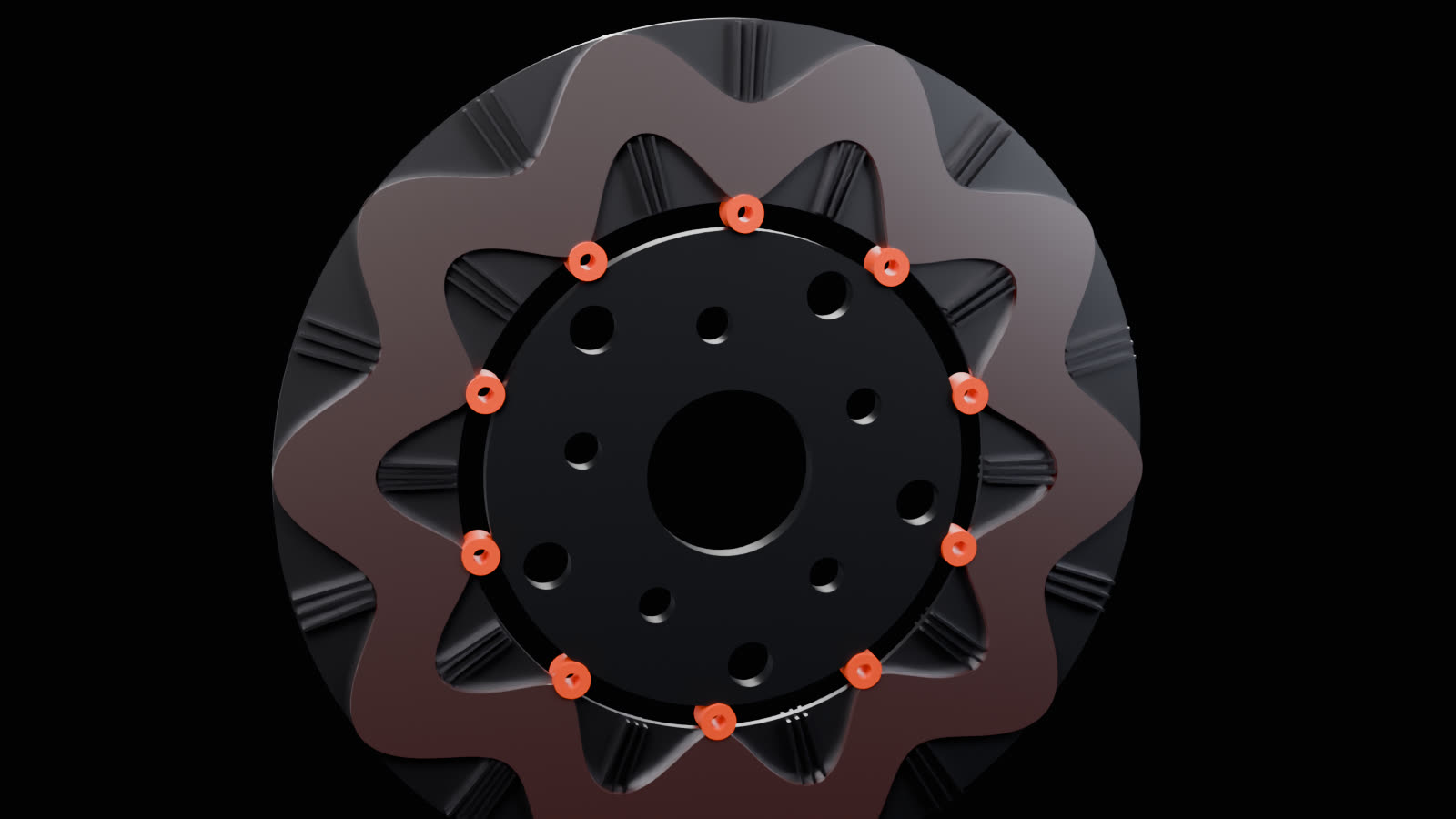
One disc, two parts.
A wave you brake on, and plates around it that hold it and cool it.
01
The pad rubs only the wave.
The shiny zigzag is the braking band, full thickness. The dark plates sit lower, so the pad never touches them.
02
The contact sweeps in and out.
As the disc turns, the wave slides back and forth under the pad. Heat and wear spread over the whole pad face instead of one stripe.
03
The plates pull the heat out.
Braking heats the wave. The finned plates around it carry that heat into the air.
04
The wave flexes. The disc stays true.
A wave can grow with heat without warping or cracking. That is how 10 mm of steel does the job of 32 mm of iron.
Today vs TORRQE
Three ways to stop a car.
Same 336 mm size, modelled in CAD. Lighter discs spin up faster and take less effort to stop, which helps handling, range and wear.
Cast iron
10.8 kg, 32 mm thick. Cheap and tough, but heavy, and it hangs off every wheel as unsprung weight.
Carbon-ceramic
3.4 kg, 34 mm thick. Light and fade-proof, but it costs many times more than iron. Top racing series use carbon discs that only work when very hot.
Wave rotor
3.7 kg, 10 mm thick. Close to carbon-ceramic weight, made from steel with standard pads.
Illustrative. Masses from our CAD models; heat and wear behaviour to be confirmed on the dyno.